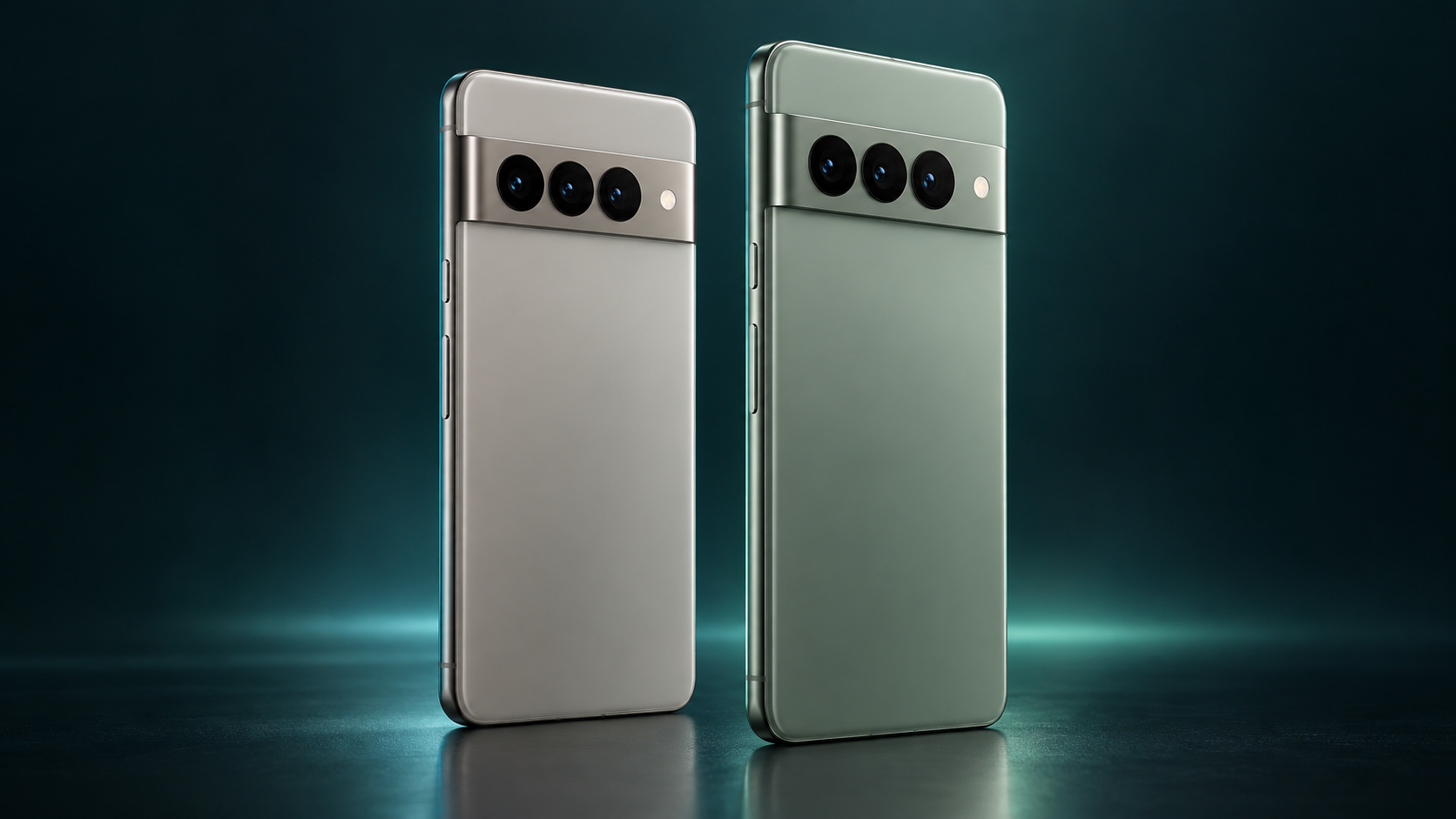
The differences that affect your purchase
| Buying question | Pixel 10 Pro | Pixel 11 Pro | Practical meaning |
|---|---|---|---|
| Display | 6.3 inches, 1–120 Hz, 3,300-nit peak | 6.3 inches, 1–120 Hz, 3,600-nit peak | Higher announced peak brightness is not a battery or sustained-brightness test. |
| Chip | Tensor G5 and Titan M2 | Tensor G6 and Titan M3 | Newer silicon is documented; app-by-app gains are not established here. |
| Base memory | 128 GB and 16 GB RAM | 256 GB and 12 GB RAM | More base storage, but no RAM increase in the entry configuration. |
| Wireless charging | Up to 15 W, Qi2 | Up to 25 W, Qi2.2 | A useful change if you regularly charge wirelessly. |
| Telephoto | 5x optical; up to 100x Pro Zoom | 5x; up to 120x Pro Zoom and a renewed sensor claim | 120x is not optical zoom and does not prove more real detail. |
| Display resolution | LTPO OLED, 1280 × 2856; 495 ppi | LTPO OLED, 1280 × 2856; 495 ppi | Published sharpness is unchanged. |
| Typical battery | 4,870 mAh | 4,850 mAh | A 20 mAh difference cannot establish real battery life. |
| Stated wired charging | Up to 55% in about 30 min with 30 W+ USB-C PPS | Up to 55% in about 30 min with 30 W+ USB-C PPS | No published wired-speed gain here. |
| Storage options | 128, 256, 512 GB or 1 TB; 16 GB RAM | 256 GB/12 GB RAM; 512 GB or 1 TB/16 GB RAM | Compare the exact storage and RAM tier. |
| Main and ultrawide cameras | 50 MP and 48 MP | 50 MP and 48 MP | Resolution stays the same; photo results still need testing. |
| Optical telephoto | 48 MP, 5x | 48 MP, 5x | 100x and 120x Pro Zoom are not optical magnification. |
| Front camera | 42 MP with autofocus | 42 MP with autofocus | No increase in selfie resolution. |
| Published rear video | 4K up to 60 fps; 8K with Video Boost | 4K up to 60 fps; 8K with Video Boost | Video Boost 8K is not ordinary local recording. |
| Protection and support | IP68; seven years of updates | IP68; seven years of updates | Each support period starts with that model’s release. |
| Local connectivity | Wi-Fi 7; Bluetooth 6; UWB; USB-C 3.2 | Wi-Fi 7; Bluetooth 6; UWB; USB-C 3.2 | No new standard is listed for these connections. |
| US SIM and launch OS | Dual eSIM; launched with Android 16 | Dual eSIM; launched with Android 17 | Check the regional model if you rely on a physical SIM. |
The display size and refresh range remain familiar. If your Pixel 10 Pro already handles your daily work, a new chip number alone is a weak reason to replace it. The Pixel 11 Pro can be easier to justify for a buyer who needs 256 GB from day one or relies on wireless charging, although the base model moves from 16 GB to 12 GB of RAM. That specification does not establish a real-world performance winner without controlled testing.
If you already own a Pixel 10 Pro
Start with the limitation you can name. I would keep the 10 Pro for everyday photography, messaging, maps and apps that already run well. Google’s seven-year support promise is tied to each generation; buying the 11 Pro does not reset the old phone’s support clock.
The upgrade is easier to defend if 128 GB is no longer enough, if wireless charging is part of your routine, or if the renewed telephoto system addresses a specific shooting habit. The 120x figure is an extreme framing option, not a complete reason to spend more. This comparison also does not establish better photos in every lighting condition.
Camera and display numbers need context
Google’s announcement describes a higher peak brightness and a renewed telephoto sensor. Those are published capabilities, not independent measurements of night scenes, portraits or backlight. A larger zoom number can include cropping and processing, so call it optical zoom only when the source does.
The 6.3-inch, up-to-120-Hz display makes the basic viewing experience a continuation. Peak brightness can help outdoors, but temperature, content and time affect what a person sees. The article therefore avoids promising longer battery life or automatically better photos.
Compare the same storage tier
Google launched the Pixel 11 Pro in the US from $1,099 and the Pixel 10 Pro from $999. Those base configurations are not identical. The official US pages do not provide a complete current offer comparison for the same storage, so the figures are historical launch anchors rather than today’s checkout prices.
Compare storage, color, tax, delivery, warranty and any trade-in value. Do not subtract two “from” prices and call the result a saving. If final prices are close, the 11 Pro gives you the newer chip, faster wireless charging and more base storage. If the 10 Pro is meaningfully cheaper at the capacity you need, it remains the sensible buy.
Which one fits your situation?
Keep a healthy 10 Pro. Buy the 11 Pro if you need 256 GB, faster wireless charging or a camera capability you will actually use and the final price is comparable. Choose a discounted 10 Pro when budget matters and its existing camera and display cover your work. For another flagship decision, read the iPhone 18 Pro vs iPhone 17 Pro comparison and the editorial method.
Short answer
The Pixel 11 Pro is a selective upgrade. Base storage and wireless charging improve, while display dimensions stay familiar and base RAM does not increase. The extra cost makes sense when it solves a concrete limitation and both offers have the same capacity. This article uses official documents checked on September 28, 2026; it is not an independent camera or battery test.