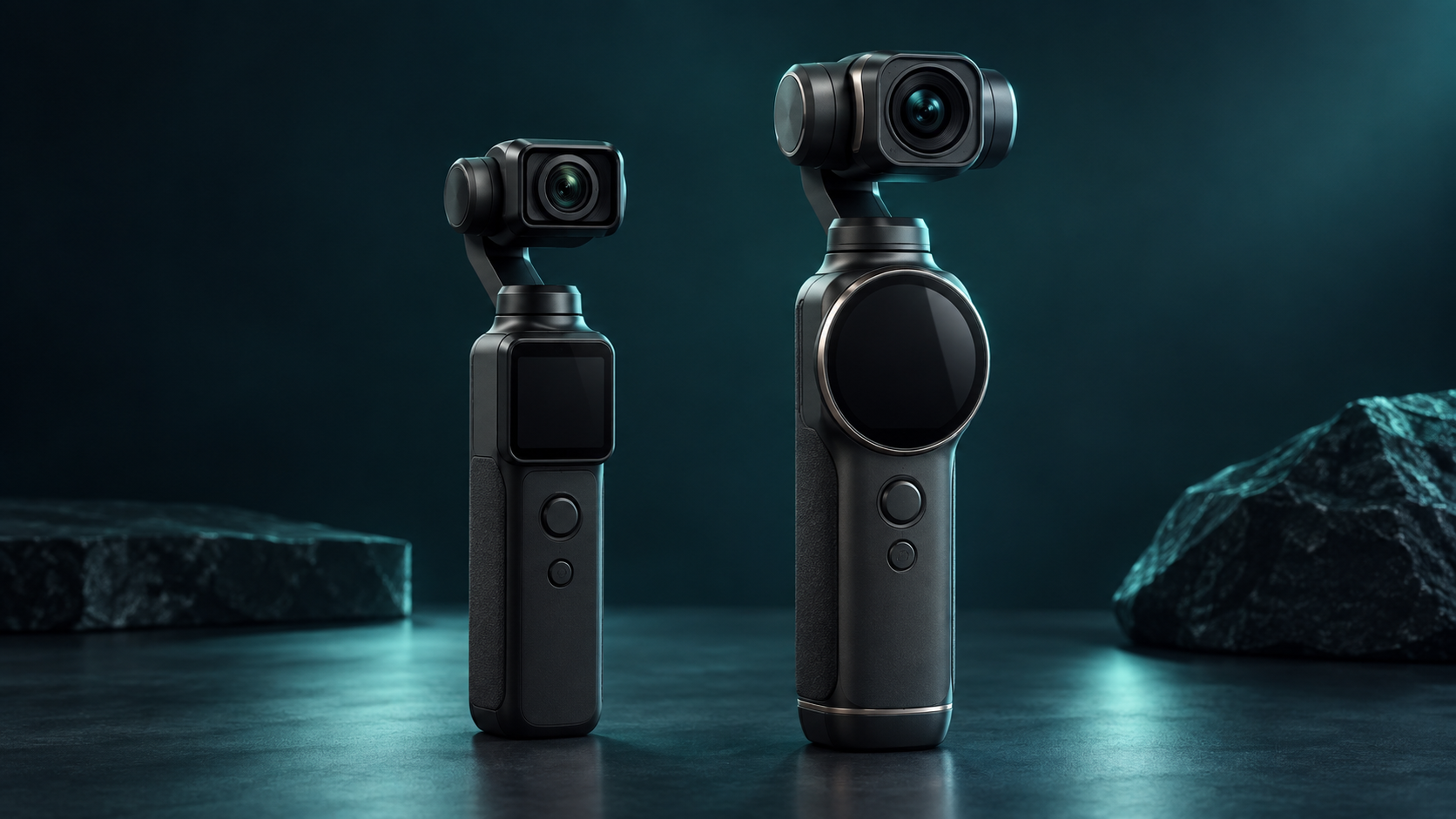
The buying differences
| Question | DJI Pocket 2 | Osmo Pocket 3 | Why it matters |
|---|---|---|---|
| Sensor | 1/1.7-inch CMOS | 1-inch CMOS | The Pocket 3 has more sensor area; useful potential in difficult light, but we have not shot a controlled comparison. |
| Normal 4K video | Up to 60 fps | Up to 60 fps | Both cover ordinary 4K60 recording. |
| Slow motion | Up to 1080p at 240 fps | Up to 4K at 120 fps in Slow Motion mode | Pocket 3 gives higher-resolution slow motion; 4K120 is not its normal video mode. |
| Screen and framing | Small fixed display | 2-inch rotatable OLED | Easier framing and switching between horizontal and vertical shooting on Pocket 3. |
| Wireless phone connection | Do-It-All Handle needed for Wi-Fi | Wi-Fi built in | Less accessory dependence when transferring or controlling footage. |
| Tracking | ActiveTrack 3.0 | ActiveTrack 6.0 | Newer tracking options for a solo presenter; results still depend on the scene. |
| Weight | 117 g | 179 g | Pocket 2 is noticeably lighter in a pocket or on a long walk. |
| Manufacturer runtime | About 140 minutes | About 166 minutes | Lab ratings at 1080p24, not a promise for 4K field use. |
| Stabilization | Three-axis mechanical gimbal | Three-axis mechanical gimbal | The Pocket 3 does not introduce the gimbal concept. |
| Equivalent lens | 20 mm; ƒ/1.8 | 20 mm; ƒ/2.0 | Similar stated field of view; aperture alone does not settle exposure. |
| Storage card limit | microSD; stated maximum 256 GB | microSD; stated maximum 1 TB | DJI lists support for larger cards on Pocket 3. |
| Video codecs | H.264 | H.264 and HEVC | HEVC can save space but requires compatible editing devices. |
| Maximum video bitrate | 100 Mb/s | 130 Mb/s | A higher published ceiling, not a measured quality verdict. |
See DJI’s Pocket 2 and Pocket 3 specifications and its upgrade FAQ. Both products use a three-axis mechanical gimbal. We have not handled either camera or compared actual footage ourselves.
If I make videos alone, is Pocket 3 worth the money?
For someone filming travel, a talking-to-camera vlog or social clips without a camera operator, yes, usually. A larger rotating screen helps you see the frame while changing orientation. Built-in Wi-Fi removes the Pocket 2’s dependence on its Do-It-All Handle for that connection. The sensor is also substantially larger on paper, and Pocket 3 offers 4K120 slow motion and newer tracking. These are workflow changes a solo creator can actually use, not just a higher number on a box.
Pocket 2 still has merits: it is lighter, records normal 4K60 and has the same basic gimbal concept. If your footage is mostly daylight walk-and-talk and you are happy with its screen and accessories, the published specifications do not make replacement compulsory. A working older camera often saves more money than the gains from another purchase.
What should I pay attention to in the listing?
The original US launch prices were $349 for Pocket 2 in 2020 and $519 for Pocket 3 in 2023, according to DJI. Those historical prices do not describe today’s market. When checked on 28 September 2026, DJI’s US store listed a standard Pocket 3 for $439, out of stock. That is a dated listing, not a guaranteed available price. Pocket 2 may only be found used or in a bundle, so compare the actual offer rather than subtracting two launch prices.
For a used Pocket 2, I would ask for a clip showing that the gimbal initializes cleanly, focuses and records with sound; check screen, battery endurance, USB port and whether the Do-It-All Handle is included if you need Wi-Fi. For any Pocket 3 offer, check whether it is the base camera or a Creator Combo. A microphone, battery handle or case can change the value more than a headline discount.
There is another important 2026 context: DJI now also lists Pocket 4 and Pocket 4P. This page compares the two models you asked about; Pocket 3 is no longer the newest Pocket model. Before buying a new Pocket 3, compare its final price with the current Pocket 4 standard kit in your country as well.
Would I upgrade from Pocket 2?
I would upgrade if I regularly struggle to frame myself, need more reliable low-light options, want higher-resolution slow motion or need the simpler wireless workflow. I would keep Pocket 2 if it serves occasional daylight clips. DJI’s 166- versus 140-minute battery estimates come from lab scenarios, so they are not enough by themselves to justify replacing the camera. A used battery’s condition can matter more.
Short answer
New creator focused on video: Pocket 3 is the more capable choice in this pair, provided stock and price make sense after checking Pocket 4 too. Existing Pocket 2 owner: keep it until its screen, sensor or connectivity genuinely limits your work. Bargain hunter: Pocket 2 can still work, but only at a low enough final price with verified condition and the accessories you require.