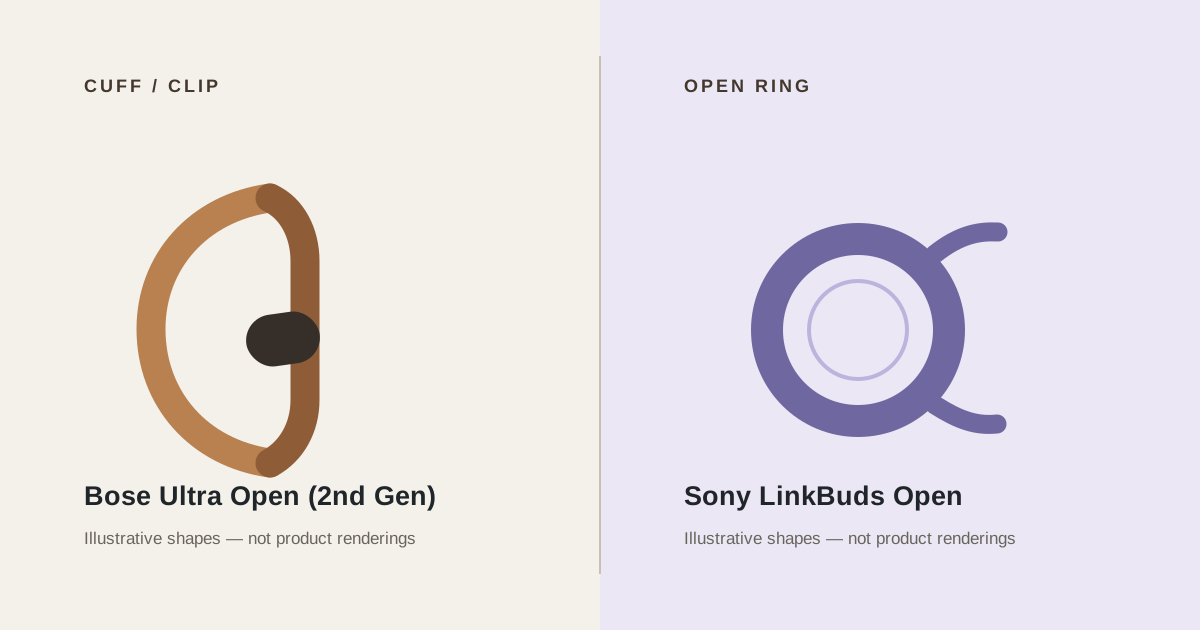
Bose Ultra Open Earbuds (2nd Gen) and Sony LinkBuds Open WF-L910 both leave the ear unsealed, but they attach differently. Bose announced its second generation on September 17, 2026, with sales scheduled to start October 1; Sony describes LinkBuds Open as an open ring design. This guide compares official specifications and announcements checked on October 27, without listening, call-quality or comfort tests. It does not check current U.S. stock or prices.
Practical differences between the two open designs
| Criterion | Bose Ultra Open Earbuds (2nd Gen) | Sony LinkBuds Open WF-L910 | What to check |
|---|---|---|---|
| Fit | Cuff or clip shape around the outer ear | Open ring driver with fitting supporters | Ear shape determines fit; try them if possible |
| Openness and isolation | Open; Bose says there is no active noise cancellation | Open design that lets ambient sound through; Sony says there is no active noise cancellation | Neither is intended to isolate outside noise |
| Advertised audio features | OpenAudio, Bose Immersive Audio and Cinema Mode | 11 mm ring driver, V2 processor and DSEE | Brand features are not comparative sound-quality tests |
| Playback per charge | Up to 9 hours, according to Bose | Up to 8 hours continuous playback, according to Sony | Claimed maximums; use and settings can reduce them |
| Additional case power | Up to 19.5 additional hours, according to Bose | Up to 14 additional hours; Sony lists 22 hours total | Do not compare totals without each maker’s conditions |
| Quick charge | The announcement reviewed does not specify quick-charge time | Sony says a 3-minute charge provides up to 60 minutes of playback | If short top-ups matter, check the mode and firmware |
| Case charging | The 2nd Gen case supports wireless charging | The documentation reviewed describes USB charging | Check whether you already have a compatible charging pad |
| Water resistance | No IP rating appears in the launch source reviewed | Sony lists IPX4-equivalent water resistance for the earbuds | Do not assume the case has the earbuds’ rating |
| Two devices | Multipoint connects two devices | Multipoint | Test switching with your own sources |
| Bluetooth and codecs | Bluetooth 5.4; SBC/AAC and aptX Adaptive on compatible Android devices | Bluetooth 5.3; SBC/AAC/LC3 | Your source device determines available codecs |
| Calls | Bose announces SpeechClarity and dedicated microphones | Sony describes Precise Voice Pickup and voice processing | These are maker-described features, not results from one mic test |
Bose’s announcement identifies the second-generation model and lists battery life, wireless case charging, multipoint and aptX Adaptive on compatible Android devices. Its launch materials do not establish better sound than Sony. Sony’s product page describes the open ring, 11 mm driver and voice technology; its WF-L910 specifications list weight, Bluetooth version, codecs and water resistance.
The table summarizes manufacturer claims, not a controlled test. In particular, maximum battery times come from different conditions and feature settings. Use them to ask what will be enabled, how long you listen at a time and whether you will recharge in the case; they do not establish a battery-life winner.
Choose with this use-case matrix
- Try Bose first if the cuff-style attachment appeals to you, you want wireless case charging, or you use aptX Adaptive with a compatible Android phone. Check the exact model and current U.S. availability before ordering.
- Try Sony first if the open ring and included fitting supporters suit your ear better, or if you value its stated quick charge and SBC, AAC and LC3 codec list.
- If you switch between a phone and computer, both list multipoint. Pair your actual devices during a trial: operating system, Bluetooth version and apps affect what you can do.
- If you need noise reduction, look for a model with isolation or active noise cancellation. Open designs let ambient sound through; they are not hearing protection or a guarantee that you will hear a hazard.
- If calls matter, test your voice where you work. SpeechClarity and Precise Voice Pickup are manufacturer feature names, not measurements in the same test.
For a different need—over-ear headphones with isolation and noise cancellation—see the comparison of Sony WH-1000XM6 and Bose QuietComfort Ultra 2. It answers a different buying question and does not test these open models.
Short answer
The most useful first difference is fit: Bose’s cuff versus Sony’s open ring. Bose claims longer per-charge playback for its second generation and a case with wireless charging; Sony lists quick charging, IPX4-equivalent water resistance and the LC3 codec. No spec by itself proves better sound, comfort or calls. Try the fit, check local availability and price, and revisit the manufacturer pages before buying.